
The short version
Kim Feller had spent years helping children with dyslexia learn to read.
She had the classroom experience. She had the parent stories. She had the teaching philosophy. She had built a school around a powerful idea: struggling readers are not broken. They need instruction that matches how their brains learn.
What she needed was a book that could carry that message beyond one conversation at a time.
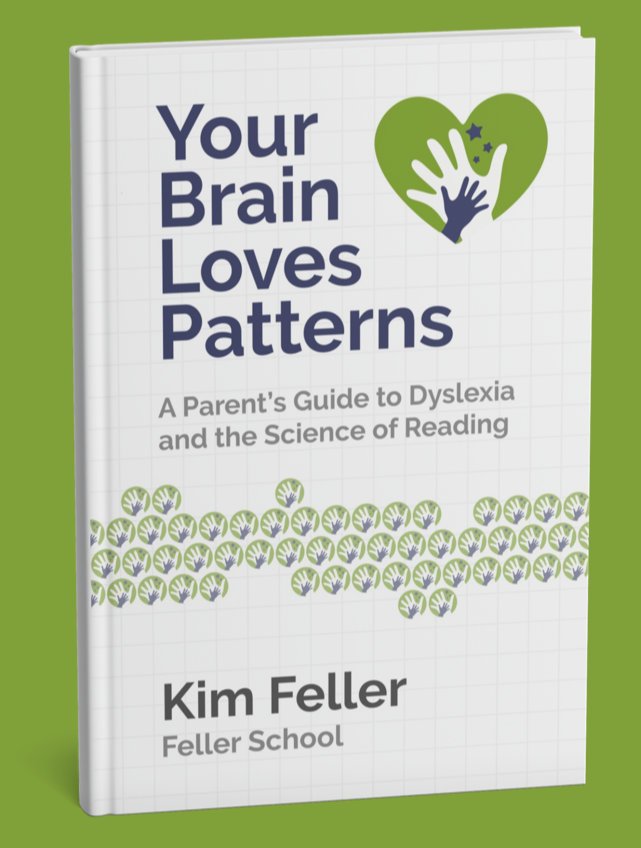
Together, we turned Kim’s experience and point of view into Your Brain Loves Patterns — a clear, readable book for parents who know something is wrong, but may not yet know what questions to ask.
What the book gave Feller School
A book is not just a book.
For a school founder, it can become a trust-building tool.
Your Brain Loves Patterns gave Feller School:
- a clear explanation of what the school believes,
- a parent-friendly introduction to dyslexia and reading instruction,
- a credibility piece for prospective families,
- a resource for conversations with educators, donors, and community partners,
- and a way for Kim’s voice and philosophy to reach people before they ever schedule a visit.
Instead of trying to explain everything in a single website page, phone call, school tour, or brochure, the book gives families a deeper entry point.
It says: here is how we think. Here is what we see in your child. Here is why reading has been so hard. Here is what better instruction can look like.
The challenge
Feller School serves families who are often arriving in a state of worry, frustration, and exhaustion.
Their child is bright. Their child may be verbal, creative, curious, funny, observant, and full of ideas. But reading is not coming easily. Homework has become a battle. Confidence is slipping.
Parents are often hearing vague advice:
- “Wait and see.”
- “Read more at home.”
- “They’ll catch up.”
- “They just need more practice.”
Kim knew there was a better explanation.
The book needed to explain dyslexia and reading instruction in plain language, reframe dyslexic students around strengths rather than deficits, and make the Science of Reading understandable without turning the book into a research paper.
Most of all, it needed to sound like Kim: direct, warm, practical, and rooted in real children.
The core idea
The breakthrough idea became the title:
Your Brain Loves Patterns
That line did a lot of work.
It was simple enough for a parent to understand immediately. It was positive without being fluffy. And it spoke directly to children with dyslexia without reducing them to a diagnosis.
The subtitle did the clarifying work:
A Parent’s Guide to Dyslexia and the Science of Reading
Together, the title and subtitle created the balance we wanted:
Curiosity + clarity.
Hope + specificity.
A parent-friendly promise + a serious educational topic.
The book we created
Instead of opening with definitions or educational jargon, the book begins with a child.
That choice mattered.
The goal was to help parents feel the human stakes first, then understand the instructional problem underneath. From there, the book walks readers through the ideas Kim explains again and again to families:
- why guessing is not reading,
- why dyslexic children often have striking strengths alongside reading struggles,
- why English is more logical than many people were taught,
- why explicit, systematic instruction matters,
- why early intervention protects both reading skills and self-confidence,
- and how parents can recognize better instruction when they see it.
The book is practical, but it is not clinical. It is hopeful, but not vague. It gives parents language for what they are seeing in their child — and a clearer way to understand what kind of help actually helps.
What I did
For Your Brain Loves Patterns, I helped shape Kim Feller’s knowledge and stories into a finished nonfiction book. The work included:
- developing the book’s central concept and positioning,
- shaping the title and subtitle,
- organizing the book around a clear reader journey,
- turning founder expertise into parent-friendly chapters,
- preserving Kim’s voice and point of view,
- editing for clarity, flow, warmth, and momentum,
- and helping the book function as both a parent resource and a thought-leadership asset for Feller School.
The goal was never to make the book sound like a generic education book.
The goal was to make it sound like Kim — only clearer, more structured, and easier for parents to follow.
Why this matters for other school founders
Many school founders carry a book inside them, whether they think of it that way or not.
They have a strong point of view. They have stories from students and families. They have language they repeat again and again on tours, in parent meetings, in donor conversations, and in staff training.
But most of that thinking disappears into one-time conversations.
A short, focused book can change that.
It can help a founder clarify what their school stands for, explain their model in plain language, build trust with the right families, and create a durable asset that keeps working after the conversation ends.
The book does not replace the school.
It helps more people understand why the school exists.
Could your school’s message become a book?
If you lead a school, learning center, education nonprofit, or mission-driven education company, you may already have the raw material for a book.
You may have:
- a philosophy you explain over and over,
- a model that parents need help understanding,
- stories that show why your work matters,
- a different way of seeing students,
- a message that could help the right families find you.
I help education founders turn that kind of expertise into short, clear, useful books.
Not giant memoirs. Not academic texts. Not ghostwritten fluff.
Focused books that clarify what you stand for and help the right people understand why your work matters.